
See How Donna Works for Contractors
Your crew is on the job site. Your phone is ringing. The homeowner who just found water in their basement isn't leaving a voicemail; they're calling your competitor.
That's not a hypothetical. It's happening right now, every day, to contractors who are good at their trade but don't have a system to answer calls while they're doing it. An answering service for contractors solves this problem, but only if it's built for the trades, not borrowed from a generic call center playbook.
This guide covers why contractors lose more calls than any other industry, what makes a contractor-specific answering service different, how to choose one, and what the three main options cost. Just what you need to make the right call.
#quote:: TL;DR: Contractors miss 50–60% of inbound calls while working on job sites, and most of those callers hire someone else within minutes. A dedicated answering service for contractors, one with trade knowledge, CRM integration, and real job-booking capability, is the most direct way to stop the revenue leak. AI-native solutions like Donna's HVAC answering service cost a fraction of human alternatives and handle calls, texts, and chat simultaneously, 24/7. If your answering service can't book a job into your CRM, it's an expensive voicemail system.
Why Contractors Lose More Calls Than Any Other Industry
The missed call problem isn't unique to contractors. However, it hits them harder than almost anyone else. The reason is structural, not behavioral.
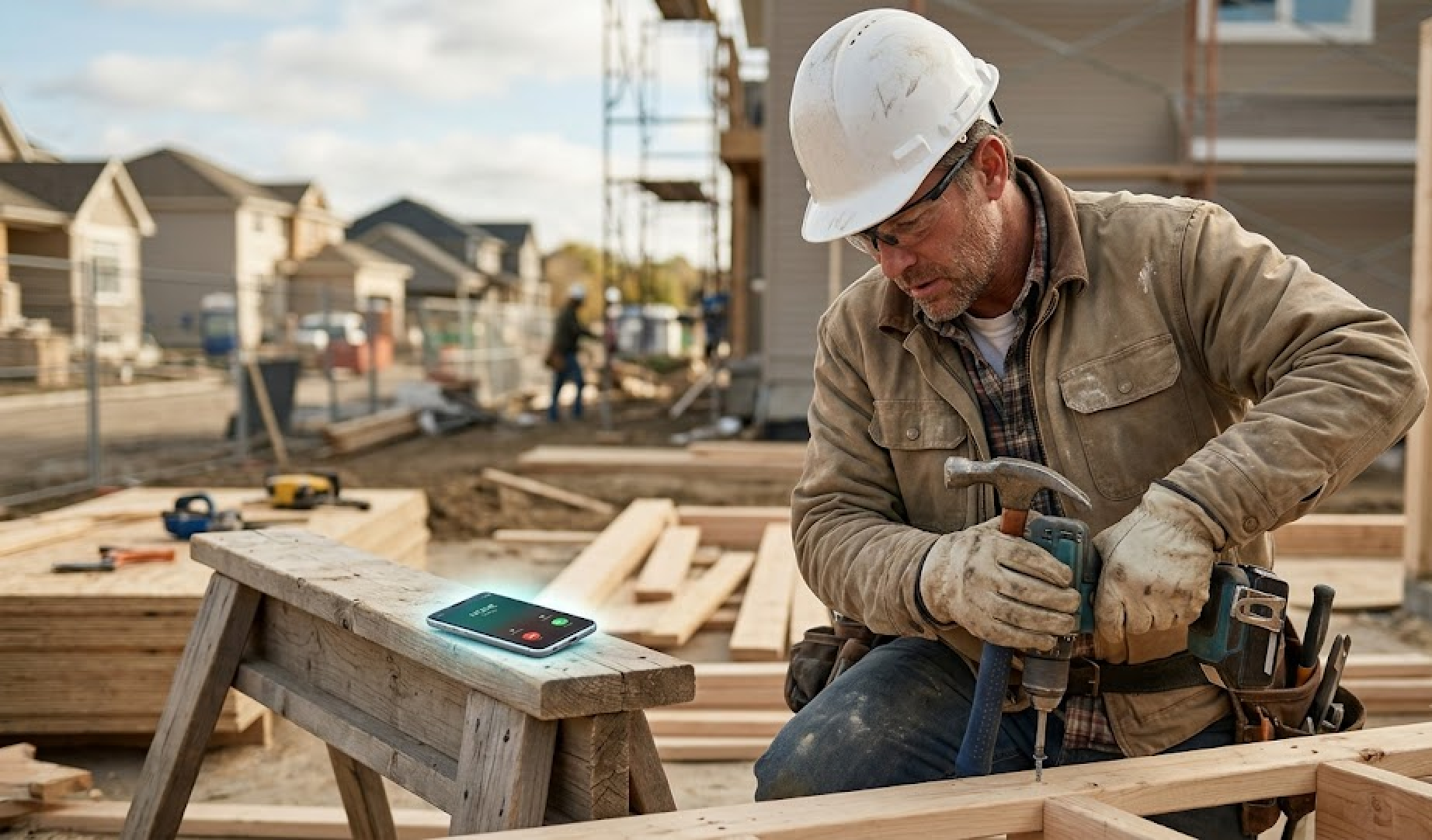
You are physically unable to answer the phone while doing your job. A plumber under a sink, an electrician in a panel, a roofer on a pitch, none of them can take a call. And unlike a retail store or an office, there's often no one else there to pick up. The phone rings on a belt clip while both hands are occupied, and the caller, who has a burst pipe, a tripped breaker, or a leaking roof, moves on immediately.
The missed call rate for home services businesses is 27% on average. During peak season or high-volume periods, contractors report missing 50–60% of all inbound calls while crews are deployed on active job sites.
The timing makes it worse. The calls you miss most often are the highest-value ones. Peak summer means every HVAC tech is dispatched, and that's exactly when emergency AC calls flood in. Storm season means every roofer has a full schedule, and that's exactly when hail damage inquiries spike. The busier you are, the more revenue walks out the door unanswered.
Missing one call doesn't just cost you one job. The average residential customer in the trades has a lifetime value of $5,000–$15,000. The $450 plumbing repair call you missed at 2 PM could have been the start of a decade-long relationship. Every unanswered ring has a number attached to it that most contractors never see, which is exactly why the problem persists.
What Makes a Contractor Answering Service Different?
Not all answering services are built for contractors, and the difference matters immediately when a caller is on the line.
Trade-specific knowledge
When a homeowner calls and says, "The compressor is making a grinding noise," a generic call center agent writes down "AC problem."
A contractor-specific answering service understands the difference between a repair call, an emergency, a maintenance request, and an estimate inquiry, and responds accordingly.
This distinction affects how the call is handled, how it's prioritized, and whether the right crew member gets notified.
Direct CRM integration
The single most important capability in a contractor answering service is the ability to book jobs directly into your scheduling software.
Whether it is ServiceTitan, Jobber, Housecall Pro, or FieldEdge, if the answering service doesn't connect to your CRM, it cannot book a job.
And if it can't book a job, it's just an expensive message relay. The job still sits in an inbox waiting for you to call back, at which point the customer may already be gone.
Dispatch capability
Different jobs need different crews. An emergency water heater replacement isn't the same as a bathroom remodel estimate.
A contractor answering service should understand enough about your business. This includes your technicians, their specialties, and your service area, to route the right job to the right person and notify them directly.
Multi-channel coverage
Calls are the primary channel, but not the only one. Homeowners text. They fill out website contact forms. They message on WhatsApp.
A contractor answering service that only handles phone calls leaves every other channel unattended.
A virtual receptionist for contractors needs to cover the whole surface area where leads arrive, not just the one channel that was most common a decade ago.
Bilingual support
In markets across the US, a significant share of homeowners prefer to communicate in Spanish.
A contractor answering service without bilingual capability loses those leads entirely. This isn't a luxury feature; it's a table-stakes requirement in most major metros.
Types of Contractor Answering Services: What's Actually Available
There are three meaningful categories. Understanding what each one does, and doesn't, determines which fits your business.
Human Answering Service
Live operators answer your calls when you can't. They follow a script, collect caller information, and relay the message to you or your office. Well-known providers in this space include AnswerForce and PatLive.
The upside is that callers speak with a human. The downside is that "human" in this context usually refers to a generalist agent managing calls across dozens of industries simultaneously.
This is not someone who knows your business, your pricing, or the difference between emergency and routine service.
Most human answering services cannot access your CRM and cannot book jobs. The most they can do is take messages. You still have to follow up.
Typical cost: $200–$2,500/month, plus per-call or per-minute fees.
Virtual Receptionist for Contractors
This is a step up from a basic answering service. A virtual receptionist for contractors is a dedicated receptionist who learns your business and handles calls with more context and continuity. Ruby Receptionists is the most recognized brand in this category.
The experience is more personalized, and the quality is higher. But the cost reflects it.
And even the best virtual receptionist operates on business hours, takes sick days, goes on vacation, and can only handle one call at a time. After-hours coverage requires a separate setup, usually at additional cost.
Typical cost: $1,000–$3,500/month, depending on call volume and hours.
AI Answering Service for Contractors
AI-native systems that answer calls automatically, without human agents.
They are trained on your specific business, your technicians, pricing, service areas, and trade terminology. They handle the full conversation, access your CRM directly, book the job, and notify your team. They work at 2 AM the same as 2 PM. They handle unlimited simultaneous calls. They don't take lunch.
This is the category where Donna AI operates. It covers calls, texts, website chat, and WhatsApp from a single system, integrated directly with ServiceTitan, Jobber, Housecall Pro, and FieldEdge.
It charges a flat monthly rate. There are no per-call fees, no overtime charges during peak season.
Typical cost: $100–$500/month flat rate.
[table]
Feature | Human Answering Service | Virtual Receptionist | AI Answering Service
24/7 Coverage | Extra cost | Business hours | Always
CRM Integration | Rarely | Rarely | Full
Books Jobs Directly | Message only | Limited | Real-time
Trade Knowledge | Generic script | Trained over time | Pre-trained on your business
Multi-Channel | Phone only | Phone only | Call + text + chat + WhatsApp
Handles Call Spikes | Queue/hold | Queue/hold | Unlimited simultaneous
Monthly Cost | $200–$2,500 | $1,000–$3,500 | $100–$500
Setup Time | Days | Weeks | Hours
[/table]
For the full-detail answering service pricing breakdown, including per-call fee calculators and how heavy call volume affects each pricing model, see our dedicated pricing guide.
How to Choose the Right Answering Service for Your Contracting Business
Use this as your evaluation checklist. Every item on this list is non-negotiable.
- Does it integrate with your CRM? If not, stop evaluating it. The entire value of an answering service lies in its ability to handle calls without your involvement. No CRM integration means every call still lands in your inbox as a task.
- Does it book jobs directly or take messages? These are fundamentally different products. Message-taking creates follow-up work. Job booking eliminates it. Ask every provider this question explicitly and ask for a demo before you believe the answer.
- Is it trained on your specific business? Generic scripts produce generic outcomes. A caller asking about a furnace replacement gets a different conversation than a caller asking about a maintenance contract. Your answering service needs to know the difference, and yours specifically, not just a general contractor profile.
- Does it cover multiple channels? Phone-only coverage has gaps. If you're not picking up texts, website chat inquiries, or WhatsApp messages from the same system, you're leaving leads on the table on every channel except one.
- What's the pricing model? Per-call and per-minute pricing looks affordable until summer rolls around and your call volume doubles. A flat monthly rate means your coverage costs don't spike during the season when you can least afford them. Always model what you'll pay at 3x your current call volume before signing anything.
Red flags in summary: Per-call pricing with no cap; no CRM integration offered or vague answers about it; scripts they can't show you in advance; no after-hours coverage as a standard feature; contracts longer than 30 days before you've seen it work.
The cost of missed calls for most contracting businesses is high enough that the evaluation time is worth it. Get this decision right, and it pays back in the first week.
Answering Services by Trade
The contractor category is broad, and the right answering service configuration varies by trade. Each sub-category below has its own page with trade-specific details.
HVAC contractors deal with the sharpest call volume spikes of any trade. Summer AC failures and winter heating emergencies arrive in concentrated windows. After-hours emergency calls are the highest-margin jobs in the business. Your HVAC answering service needs to be operational 24/7 and capable of booking same-day emergency slots.
Plumbing contractors handle a high proportion of emergency calls, such as burst pipes, water heater failures, and sewer backups. The answering service for plumbers needs to distinguish emergency from routine, route appropriately, and book fast.
Electrical contractors balance emergency work (panel failures, no power) with estimate requests for larger projects. The answering service for electricians needs to qualify the call type and route it correctly. An emergency dispatch and a project estimate require entirely different responses.
Roofing contractors are highly seasonal and heavily storm-driven. A single hail event can generate hundreds of calls in 24 hours. The answering service for roofers needs to handle volume spikes without degrading quality, something human services struggle with during weather events.
General contractors manage broader project types, such as remodels, additions, renovations, and longer sales cycles.
The Bottom Line
The missed call problem for contractors is structural. You can't answer the phone while you're on a ladder, in a crawlspace, or running a crew across three job sites. That's not a discipline failure; it's simply the nature of field work. But the calls don't stop because you're busy. They just go somewhere else.
An answering service for contractors closes that gap.
The right one doesn't just pick up the phone; it understands your trade, accesses your schedule, books the job, and notifies the right technician before you've climbed back down the ladder.
The wrong one takes a message and creates a pile of callbacks that your busiest days don't have room for.
The first responder wins 78% of home service jobs. If your competitor answers the call and you don't, the job is theirs. Not because they're better, but because they picked up.
Fix the answering problem first. Everything else in your business gets easier when the phone is covered.
#cta::See Pricing::https://donnaio.ai