
Stop Paying Per Call. Start Booking Every Job.
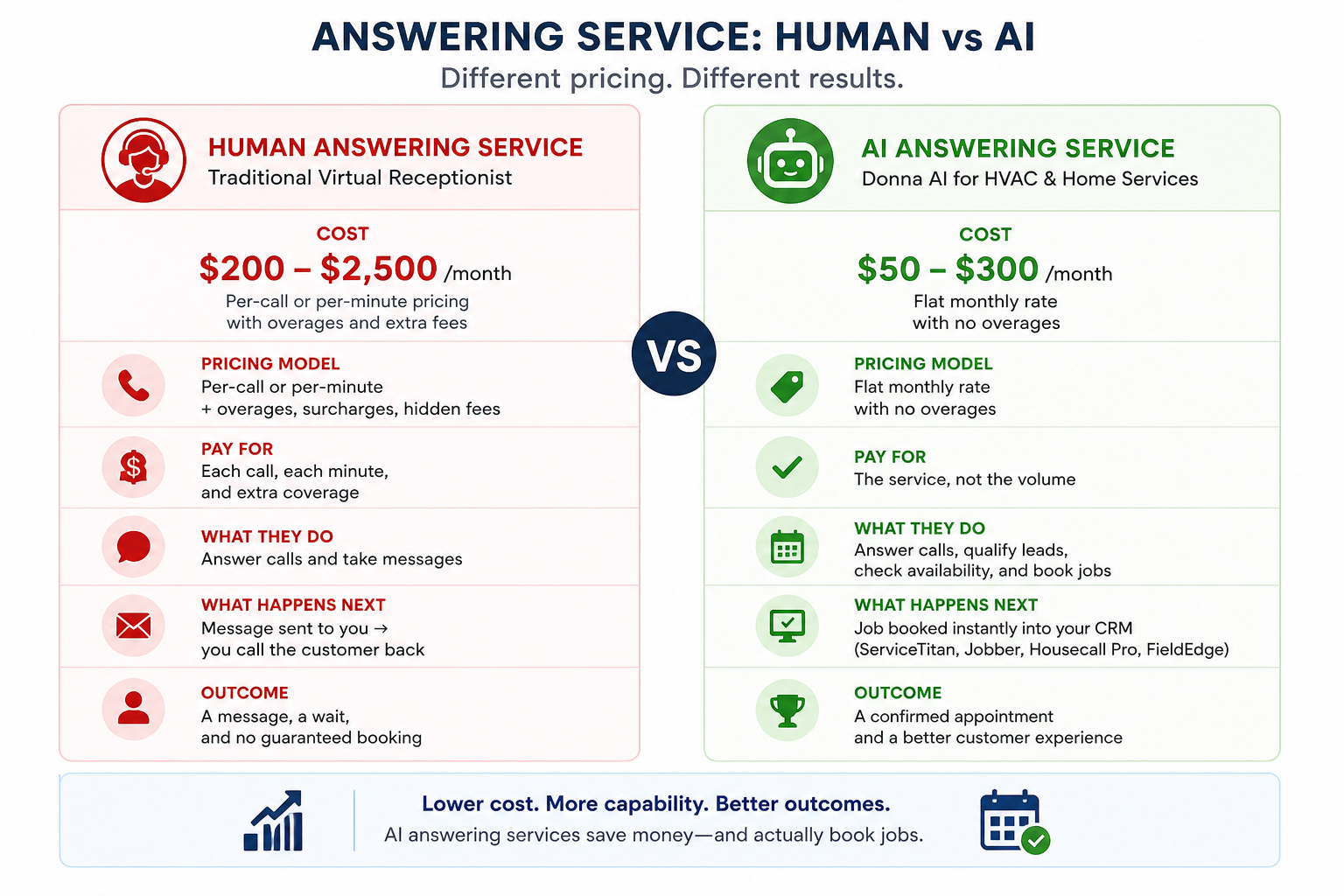
How much does an answering service cost? In 2026, human answering services run $200–$2,500/month. AI-powered services charge a flat $50–$300/month. That's the range, but the number on the pricing page is rarely what HVAC companies actually pay.
Per-call fees, after-hours surcharges, holiday premiums, and overage charges stack up fast. A service advertised at $0.75/call can quietly cost you $1,200/month by July. And that's before you factor in what it still can't do: book a job, check tech availability, or touch your CRM.
This guide gives you the real numbers across every pricing model, per-call, per-minute, and flat-rate, so you can compare what you're actually paying against what you're actually getting.
#quote:: TL;DR: In 2026, answering services cost between $50–$300/month for AI-powered solutions and $200–$2,500/month for human services, depending on call volume and features. Most traditional services charge per call ($0.75–$1.25/call) or per minute ($1.00–$1.50/min), with additional fees for after-hours, holidays, and setup. AI answering services charge a flat monthly rate with no overages, and unlike human services, they can actually book jobs directly into your CRM.
How Much Does a Traditional Answering Service Cost?
Traditional human answering services, also called virtual receptionist services, use three main pricing models. Each one has a different way of costing you more than you expect.

Per-Call Pricing ($0.75–$1.25 per call)
The most common model. You pay a fixed amount for each call the service answers. Sounds simple until you do the math.
A busy HVAC company during peak season can take 400–600 calls per month. At $1.00 per call, that's $400–$600/month, before you even include add-ons. Add after-hours premiums (typically 20–30% more), and your real bill climbs fast. During a heat wave, when you need coverage the most, your costs spike exactly when you can least afford distractions.
[table]
Volume | Cost
Low Volume | ~$225/mo ~300 calls/mo at $0.75/call
Medium Volume | ~$500/mo ~500 calls/mo at $1.00/call
High Volume | ~$750/mo ~750 calls/mo at $1.50/call
[/table]
Per-Minute Pricing ($1.00–$1.50 per minute)
Some services are priced by the minute instead of by the call. The average answering service call runs 2–4 minutes. At $1.25/min, a 3-minute call costs $3.75, which is more expensive than per-call pricing at most volumes. Per-minute pricing tends to favor the service provider, not you.
Monthly Plans with Overage Charges
Many services offer bundled monthly plans, 100 calls for $150/month, for example, that look affordable at first. The problem is overages. Exceed your included minutes or calls, and you pay penalty rates (sometimes 2x the base rate) on every additional call.
For seasonal businesses like HVAC, this model is particularly punishing: you pay for unused capacity in slow months and get slammed with overages in busy ones.
Hidden Fees That Add Up Quietly
Beyond the advertised rate, most traditional answering services charge for:
- Setup fees: $50–$200 one-time
- Holiday surcharges: 1.5x–2x rate on federal holidays
- After-hours premiums: 20–40% more for evenings and weekends
- Message delivery fees: Charges per text or email notification sent to you
- Script change fees: Billed when you update your call-handling instructions
- Cancellation fees: 30–90 day notice requirements with penalty clauses
#quote:: Key takeaway: When you add per-call rates, after-hours premiums, holiday surcharges, and overage fees together, a "budget" answering service at $0.75/call routinely costs HVAC companies $600–$1,200/month in real spend.
What Does a Human Answering Service Actually Do?
Before comparing prices, it's worth being precise about what a traditional answering service delivers because most HVAC owners discover the limitations too late.
A human answering service answers your phone and takes a message. That's it. The operator collects the caller's name, number, and the reason they called. They send it to you via text or email. You then call the customer back, sometimes hours later.
What A Traditional Answering Service Cannot Do
- Access your scheduling software or CRM (ServiceTitan, Jobber, Housecall Pro, FieldEdge)
- Check your technicians' availability in real time
- Book a service appointment directly
- Answer technical questions about your services or pricing
- Handle SMS, website chat, or WhatsApp, and only phone calls
- Distinguish between a $150 tune-up and an emergency call at 11 PM
#quote:: The honest summary: You are paying a human answering service to create a to-do list for you. Every message they take is a task you still have to complete, a call back you have to make, a job you still haven't booked.
The caller who needed an emergency AC repair at 9 PM? They didn't wait for your call back. They called your competitor.
How Much Does an AI Answering Service Cost?
AI-powered answering services work on a fundamentally different pricing model: a flat monthly rate with no per-call charges and no overages. You know exactly what you'll pay before the month starts, regardless of call volume.
In 2026, AI answering service pricing typically falls into these tiers:
[table]
Plan | Price | Features
Starter | $50–$99/mo | Basic call answering, message taking, and limited integrations
Professional | $149–$249/mo | Full call handling, CRM booking, SMS, multi-channel
Business | $249–$350/mo | Unlimited volume, custom workflows, priority support
[/table]
Donna AI, purpose-built for HVAC and home services businesses, operates on a flat monthly rate that is 5–6x cheaper than hiring a human office manager. And unlike a human office manager, Donna is available 24/7, never calls in sick, and handles spikes in call volume without batting an eye.
What's Included in the Flat Rate?
A flat-rate AI answering service includes capabilities that human services charge extra for, or simply can't provide:
- Unlimited inbound calls, texts, website chat, and WhatsApp messages
- Direct job booking into your CRM (ServiceTitan, Jobber, Housecall Pro, FieldEdge) is included, not an add-on
- Real-time technician availability checking
- 24/7 coverage, including evenings, weekends, and holidays at no extra charge
- Bilingual call handling (English and Spanish)
- Instant customer confirmation and follow-up messages
The pricing difference in plain terms: A traditional service might cost you $1,200/month and leave customers on hold, unable to book. An AI answering service at $199/month answers every call instantly, books the job, and syncs it to your CRM, no callback required.
Answering Service Cost Comparison: Human vs. AI
Here is a direct, feature-for-feature comparison of what you get from each type of service at typical price points.
[table]
Feature | Traditional Human Service (~$800–$2,500/mo) | Donna AI (Flat monthly rate)
Pricing model | Per-call or per-minute + overages | Flat monthly rate, no overages
After-hours coverage | Available, with a 20–40% surcharge | ✔ Included, no surcharge
Holiday coverage | Available, 1.5x–2x rate | ✔ Included, same flat rate
What happens after answering | Message taken → you call back | ✔ Job booked instantly
CRM integration | ✘ Cannot access your CRM | ✔ Books into ServiceTitan, Jobber, Housecall Pro, FieldEdge
Checks tech availability | ✘ No | ✔ Yes, in real time
SMS/website/chat / WhatsApp | ✘ Phone only | ✔ All channels included
Bilingual (English/Spanish) | Sometimes, at extra cost | ✔ Included
Caller result | A message, a wait, and hope | A confirmed appointment
[/table]
The Hidden Cost Nobody Talks About: Missed Revenue
Every conversation about answering service pricing focuses on what you pay. Almost nobody talks about what you lose.
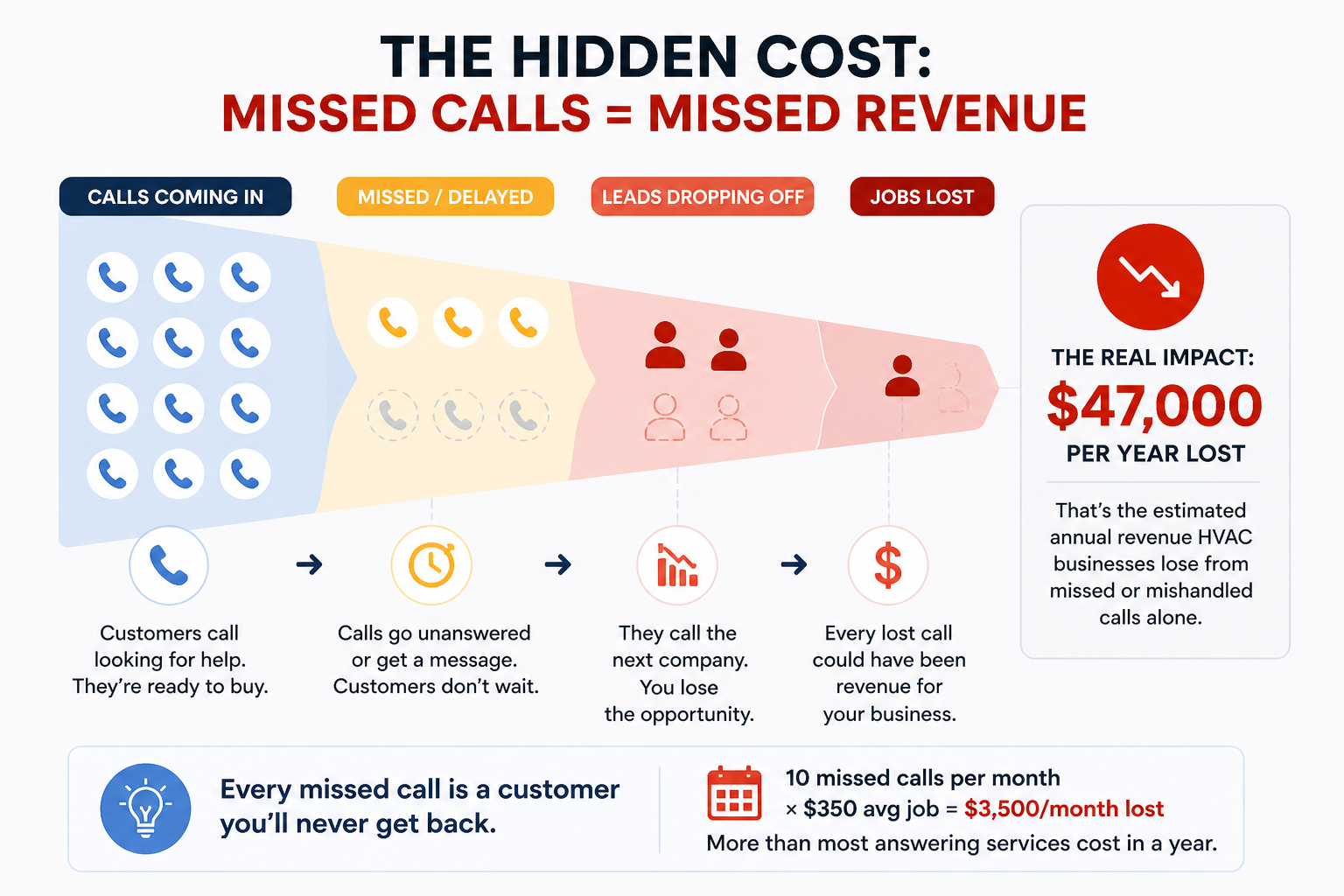
HVAC businesses that miss calls, or answer them but can't book on the spot, lose an estimated $47,000 in revenue per year from missed or mishandled calls alone.
That's not a theoretical number. It's the cumulative cost of callers who didn't leave a voicemail, callbacks that came too late, and after-hours emergencies that went to a competitor who could actually schedule them.
Consider what happens with a traditional answering service at 10 PM on a July night. Your customer's AC goes out. They call. The operator takes a message. They send it to you. You're asleep. The customer waits 20 minutes, then searches Google and calls the next HVAC company, the one who actually scheduled the repair on the spot.
The cheapest answering service is still expensive if it can't book the job. A service that charges $200/month but fails to capture even two $400 jobs per month is net-negative. A service that costs more but converts every after-hours call into a scheduled appointment pays for itself on day one.
The real math: If your average job ticket is $350 and you're missing 10 after-hours calls per month due to a message-only service, that's $3,500 in lost revenue every month, more than the annual cost of most AI answering services.
When evaluating answering service cost, the right question isn't "how much does this HVAC service charge?" It's "how much revenue does this service protect?"
Virtual Receptionist Cost vs. AI Answering Service: Which Is Right for HVAC?
A virtual receptionist is a human agent, often working remotely for a staffing company, who handles calls as if they were your in-house receptionist. They can be trained on your business, handle nuanced conversations, and manage complex scheduling. They also cost $25–$65/hour or $1,500–$4,000/month for full coverage.
For HVAC companies specifically, the gap between what a virtual receptionist can offer and what an AI answering service can deliver is narrowing fast. The one thing human agents can offer is genuine conversational flexibility for unusual situations.
But the vast majority of HVAC calls involve scheduling, pricing questions, service area confirmation, and dispatch priority. They are repeatable, rule-based interactions that AI handles accurately and instantly.
For most small and mid-size HVAC operators, the math is straightforward: An AI answering service handles 95% of your calls at 10–15% of the cost of a full-time receptionist, with the same 24/7 availability and direct CRM booking capability.
Check out our curated list of the 7 best AI answering services for small businesses.
What to Look for When Comparing Answering Service Pricing
Before you sign up for any answering service, get clear answers to these questions:
What is the total monthly cost at my actual call volume? Ask for a sample bill based on your last 90 days of calls.
What happens after the call is answered? A message is not a booking. Know exactly what the caller experiences.
Does the service integrate with your CRM? If not, every answered call still creates manual work for you.
Is after-hours coverage included or extra? After-hours is when HVAC emergencies happen. It should not be a premium add-on.
What are the contract terms? Month-to-month is the standard now. Avoid 12-month lock-ins for a service you haven't tested.