
Don’t Let HVAC Leads Go to Voicemail
A high-velocity HVAC system is a legitimate solution for homes where installing conventional ductwork isn't practical.
For example, many older and historic homes weren't designed for modern ductwork. And adding a conventional HVAC system often requires major renovations.
A high-velocity system avoids most of that by using narrow, flexible ducts that fit inside existing walls and ceilings.
If your home doesn't fall into that category, a standard ducted system or a mini-split is usually the better choice for both cost and efficiency.
This guide covers exactly what a high-velocity HVAC system is, how it works, and what it costs to install in 2026.
It will help you decide whether a high-velocity HVAC system works for your home.
Let’s get to it.
The Short Answer
A high-velocity HVAC system uses small, flexible 2- to 3-inch ducts to deliver conditioned air at high speed. It's designed for homes where conventional ductwork won't fit. The installation cost is between $6,000 and $18,000 for most homes, which is higher than a standard system. The noise is real but manageable in a well-installed system. A high-velocity HVAC system is the right choice for older and historic homes where no better option exists. But it isn’t best for homes where standard ductwork or a mini-split already works.
What Is a High-Velocity HVAC System?
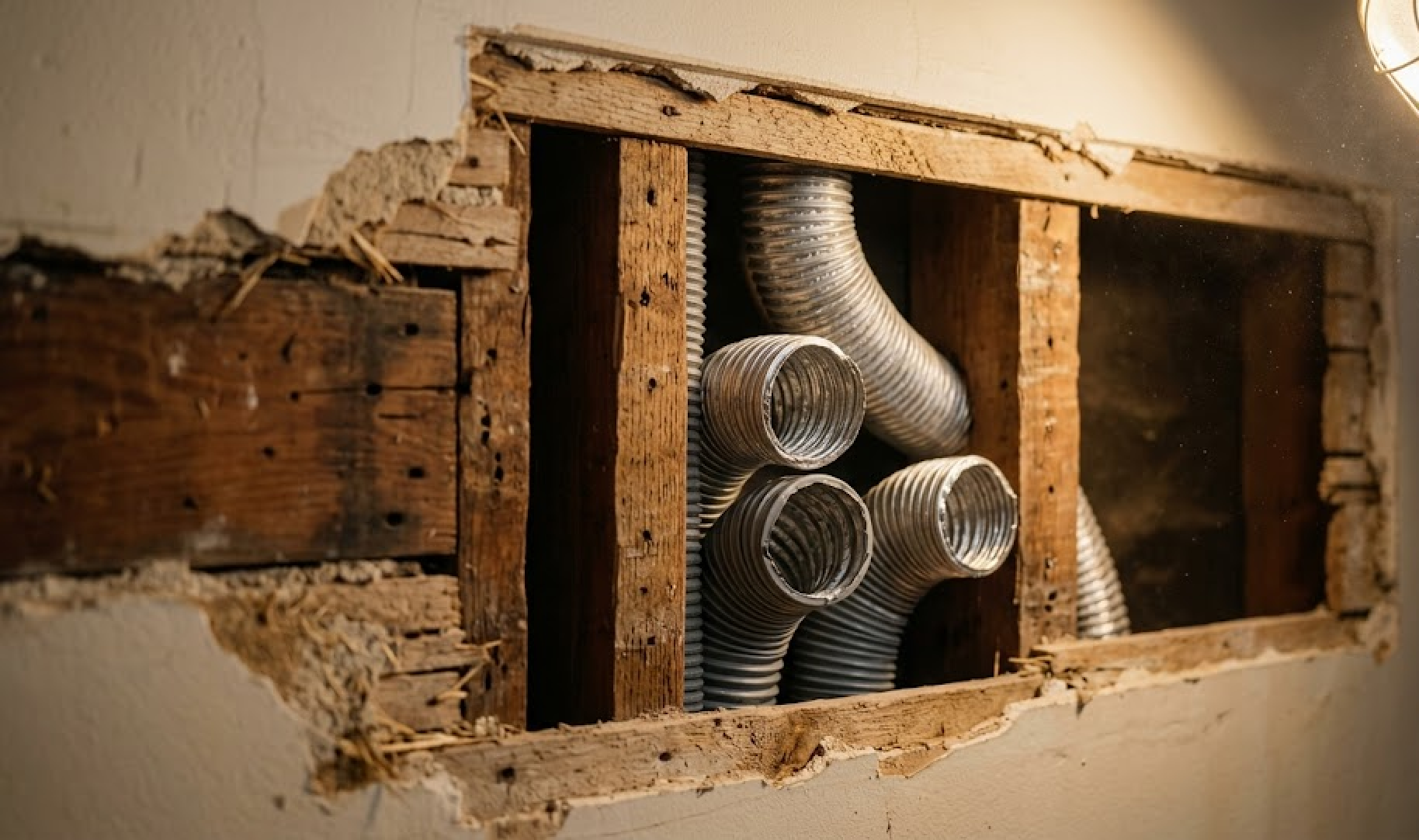
A high-velocity HVAC system, also called a small-duct system, is a heating and cooling system that uses small, flexible ducts instead of traditional large ductwork.
The ducts are typically 2 to 3 inches in diameter, compared to the 10 to 14-inch ducts used in conventional systems.
And the smaller duct size is the entire point.
These tubes can be snaked through wall cavities, around structural beams, through closet floors, and into tight spaces where standard ductwork simply cannot go.
The result is whole-home conditioning without major structural work.
How a High-Velocity System Works
The system operates on higher pressure and higher airflow speed than a traditional HVAC setup.
The air handler sits in a utility space, attic, or closet.
A specialized blower pushes air through the small ducts at about half the airflow of a conventional system, but at a much higher speed to deliver the same heating and cooling.
The reduced airflow volume through smaller ducts creates a greater temperature differential between supply and return air, about 10 to 15 degrees more than a standard system, which allows the system to condition air effectively despite the compact delivery mechanism.
The outlets are small round vents, typically two inches in diameter. This allows it to be placed on floors, walls, or ceilings. It can also be painted or stained to match the surrounding surface.
Because the air moves much faster, the system creates what manufacturers call an aspiration effect: incoming air mixes quickly with room air rather than blowing in a concentrated stream. This distributes temperature evenly and eliminates the drafty feeling common in conventional forced-air systems.
Pros of a High-Velocity HVAC System
- Fits where conventional ductwork cannot.
The flexible 2- to 3-inch tubing can navigate structural obstacles that would require demolition to route standard ductwork around.
For homes that can't support traditional ductwork, a high-velocity system may be the only realistic way to get whole-home comfort. This is true for Victorian homes, a colonial with plaster walls, or a row house with no existing duct space.
- Minimal disruption to existing structures.
Installing flexible small-duct tubing through existing wall cavities typically requires smaller access holes and less drywall work than running full-size rectangular ducts.
This is significant for a historic home where preserving original finishes matters.
- Superior humidity removal.
High-velocity systems are designed to remove more moisture from indoor air than standard systems.
By moving air faster and delivering it at a lower temperature, the system creates more condensation on the coil and removes more humidity from your home.
It also creates noticeable comfort in humid climates.
- Even temperature distribution.
The aspiration effect from high-velocity delivery mixes room air without directing a stream of conditioned air at any particular spot.
The result is more uniform temperature throughout a room with fewer hot or cold zones.
- Discreet vents.
Two-inch circular outlets are far less visually prominent than standard rectangular registers.
They can be recessed and finished to match wall or floor materials, which is an advantage in period homes where exposed hardware conflicts with the aesthetic.
Cons of a High-Velocity HVAC System
Higher upfront cost.
A high-velocity system costs more to install than a standard central air system.
The specialized equipment, the custom blower unit, and the labor required to integrate small-duct tubing through existing structures add up the price.
This is the most consistent objection, and it's legitimate.
2. Noise.
High-velocity systems are louder than conventional forced-air systems at the vents. The higher airspeed through smaller outlets creates an audible whooshing sound.
Installation quality plays a major role in noise levels. Systems with properly installed sound-attenuating tubing operate much quieter than poorly installed systems.
3. Lower energy efficiency than alternatives.
High-velocity systems are not the most efficient option available. They are generally less energy-efficient than standard central AC systems and substantially less efficient than modern mini-splits.
When feasible, conventional ductwork or a mini-split is the better choice for long-term energy savings.
4. Specialized maintenance.
High-velocity systems require technicians who understand it’s specific components and pressure requirements.
In areas where the technology is less common, finding qualified service technicians can be harder than for standard systems.
5. Not ideal for larger homes.
High-velocity systems perform well for homes in the 1,200 to 2,200 square foot range.
For larger homes with significant heating and cooling demands, the capacity requirements and associated cost can make them less practical.
High-Velocity HVAC Cost in 2026
Here is what a high-velocity small-duct system costs to install in 2026.
[table]
Home Size | Typical Installed Cost | Notes
1,200–1,500 sq ft | $6,000–$9,000 | Fewer duct runs, simpler retrofit
1,500–2,000 sq ft | $9,000–$13,000 | Mid-range equipment, moderate labor
2,000–2,200 sq ft | $13,000–$18,000 | Complex retrofit, additional zones
[/table]
The average installation cost for a mid-range home is approximately $10,500.
For comparison, a conventional central split system with existing ductwork runs $3,500 to $14,000 installed, averaging around $7,500 for a standard home.
A mini-split system for the same square footage typically runs $3,000 to $10,000 depending on the number of zones.
What drives the cost up:
- Retrofit difficulty in older homes with limited access
- Number of terminal vents required (each zone adds cost)
- Local labor rates (Midwest installs run lower than coastal markets)
- Electrical upgrades if the existing panel needs capacity added
- Permit and inspection fees (these vary significantly by municipality)
What to ask for in quotes: A complete quote should include the blower unit, coil, condenser, all tubing and fittings, all terminal vents, permit handling, any required electrical work, and a static pressure test on completion. Quotes that exclude electrical or permits can look cheaper than they are.
Is a High-Velocity System Right for Your Home?
A high-velocity HVAC system is the right choice if your home meets these conditions:
- You have an older home, historic property, or urban row house without existing ductwork.
- Adding conventional ductwork would require significant structural work or damage to original finishes.
- You want whole-home conditioning without wall-mounted mini-split units in every room.
- Your home is between 1,000 and 2,200 square feet.
It is not the right choice if:
- Your home already has ductwork that can be reused or reasonably replaced
- Energy efficiency is a top priority.
- Your budget is tight.
- Your home is larger than 2,200 square feet.
High-Velocity vs Mini-Split vs Traditional HVAC
[table]
| High-Velocity | Mini-Split | Traditional Ducted
Best for | Older homes, no duct space | Any home, especially additions | Homes with existing ductwork
Install cost | $6,000–$18,000 | $3,000–$10,000 | $3,500–$14,000
Energy efficiency | Moderate | Highest | Moderate
Ductwork required | Yes (small-duct) | No | Yes (large-duct)
Retrofit disruption | Low to moderate | Very low | Moderate to high
Noise level | Moderate (audible airflow) | Very low | Low
Visible hardware | Small 2-inch vents | Wall units in each room | Standard registers
Humidity removal | Excellent | Good | Good
[/table]
If you want the highest efficiency, choose a mini-split.
If you want to hide the air distribution without large ducts, a high-velocity system is a good option, although it typically costs more.
And if your home already has usable ductwork, a traditional central system usually provides the best value.
Conclusion
A high-velocity HVAC system is a practical solution only when space constraints make conventional ductwork impractical.
It is not the most efficient or most affordable option. Mini-splits outperform it on energy efficiency, and standard ducted systems cost less when ductwork is already in place or can be added without significant structural work.
If you're a homeowner evaluating options, make sure to ask your contractor about all three system types. Also confirm if they have first-hand experience installing a high-velocity HVAC system, should that be your preferred option.
And if you're a contractor handling high-velocity inquiries, make sure every potential customer who calls you gets answered before they find someone else. Our HVAC answering service covers how to ensure no inquiry goes unaddressed.